Seeing more clearly through winter storms

It was breath-taking, and I had not noticed - Maureen McCann Waldron
It’s the first Sunday of Advent in the Catholic Church calendar. It’s also a Thanksgiving weekend with a surprising amount of snow here in Ohio and the rest of the northeastern United States. Whether you’re a Catholic, Christian, or religious at all, it’s been a few days of deciding whether to stay under the blankets - literally and metaphorically - or to engage with the world.
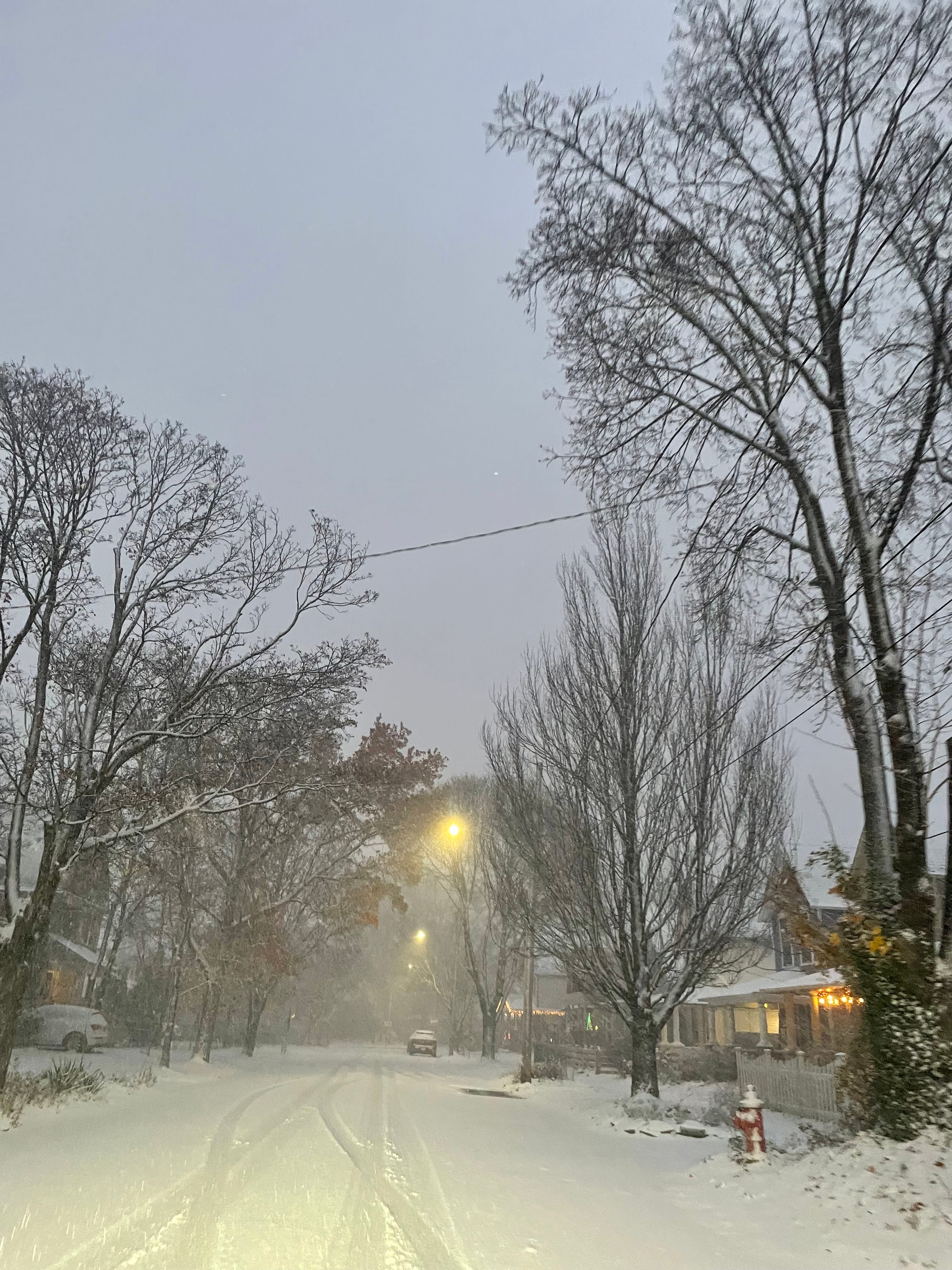
The swirling snow matches the swirling of my mind, caught up in Christmas gift lists, lists of holiday parties, travel itineraries, final classes, grading, manuscripts that need writing and reviewing, and Spring semester plans that need finalizing. Not to be forgotten are fun family dynamics as we are thrown together once more for the holiday season, and the generalized anxiety over the state of the world - will there be military action on Venezuela while we visit Trinidad? Can food banks survive as they try to help so many hungry survive? - as Black Friday offers stuff our inboxes from early November on.
Yet, even in its swirling, snow inspires stillness. It dampens the sound of everything whirring and crashing in the world about us. The frigid quiet calls to mind much of what is invoked in this Advent time: readings and reflections about discernment, particularly discernment to see the light in the midst of darkness, the stillness and calm in the midst of storm. It is a time, as heard in one homily, after the busyness and bombardment of the past year, “to let our souls catch up to our bodies.” Again, whether you believe in souls or not, I think what resonated with me was the need to create space for seeing and hearing what really matters more clearly at this time of year. It’s time to awaken and engage more mindfully with the world as we mark the end of one year and step forward into another (whether we like it or not).
What does it take to have this discernment, this mindfulness? Words of wisdom from the recent conference I attended on managing the unexpected and collective mindfulness come to mind. It will take noticing, intuiting, looking, seeing, maybe even parsing and questioning the categories we automatically draw on, so that what we know is more vivid and alive, more feeling and useful. From these scholarly notions I’d reinforce one option in particular: to discern the current state of the world, to remain alert to injustice, and to awaken to the sense that “this is not normal,” can also involve moments of quiet. Quiet to heal the self, and to repair the senses. Quiet to practice hearing when it seems like there is nothing to hear, paralleling the daily struggle to hear good news when only the bad overwhelms our feeds, algorithms and headlines. We need dedicated times to contemplate and be still so we can feel better, as in feel what is unfolding around us more deeply and accurately. So we can get better at tuning into the holistic situation around us with all our senses and experiences and stirrings of the heart and soul.
By carving out some quiet this season, we may get better at anomalizing the happenings that bombard us from the fire hose of (mis)information around us. We might slowly re-awaken to see:
Cruelty is an anomaly not because it is rare but because we aspire for kindness
Apathy is an anomaly not because we don’t feel it ourselves but because people the world over share a history of creative non-violent resistance to injustice
Retreating into self-isolation is an anomaly because our core selves are screaming for connection, despite the immense capabilities afforded by the digital companions in our palms. If we stood still for a minute or two, we just might hear and respond to their cries this winter.
Anomalizing this past year is pretty important. If we accept as normal masked men grabbing and throwing people into vans, bullying as a negotiation tactic, and the denigration of those who question power, then we indeed live in a mindless world. If, instead, in the swirling downpour we can pause long enough to quietly feel what matters, what makes us human - our shared dignity, love and forgiveness that stretches past boundaries, justice with mercy (just as we would want for any of our kids) - then we have a chance. We have a chance to again claim what we believe to be good and human and to speak up about the signals that tell us we are deviating from that.
As the snow continues to drift and bank, to blanket and dampen my own little world, I think I’ll claim some quiet today, thankful for what I can discern out of the beautiful blankness.